Employee Success Hub
Coordinates
Onboarding, training, certifications, benefits, performance/career pathing, and role-aware next steps.
Emma sees
Missing steps, readiness gaps, role context, and next-best action.

Native surfaces. Unified intelligence. Conducting every part of the business into one seamless flow.
Active design partner conversations underway in healthcare — MVP live and demo-ready.
Request access to the live demo environment and seed round materials.
Sources: ¹ Productiv SaaS Management Index 2023 · ² Gartner Application Waste Report 2023 · ³ Grand View Research, Workforce Management Market 2024 · ⁴ Internal market sizing based on TAM analysis across orchestration, ERP, and HCM platforms
Founder Proof

Clint Porch has spent 25+ years building and managing enterprise healthcare technology at scale — strategy through launch to P&L, including systems supporting 2M+ members across payer, provider, and patient ecosystems. Today he leads Health Solutions Strategy & Growth at Florida Blue, one of the largest health plans in the country, driving end-to-end product development across member-facing platforms at enterprise scale.
He also operates a home care agency, where fragmentation is not theoretical. It shows up in workforce readiness, compliance, communication, handoffs, and operational follow-through.
FlowNav is not built from a market thesis. It is built from direct operating experience with the fragmentation it is designed to replace.
— Clint Porch, Founder & CEO
FlowNav is actively raising its Seed round. MVP is live. Design partner conversations are underway.
Businesses are drowning in fragmentation — too many disconnected tools, too much switching, and too little coordination. AI made individual tools smarter. It did not fix the coordination layer underneath them — it made it worse.
FlowNav replaces that sprawl with an AI-orchestrated operating system: native surfaces, unified intelligence, and coordinated execution across the business.
The work happens inside FlowNav, not across disconnected point solutions.
Context moves with the operation instead of being trapped inside separate tools.
Emma guides the right action for the right role at the right moment.
Workforce operations proves the system before FlowNav expands across the rest of the business.
Incumbents are built as systems of record.
FlowNav is built as a system of orchestration.
You cannot retrofit that.
Workforce operations is the right entry point because it is where coordination pain is immediate, measurable, and expensive. In high-turnover, high-compliance environments like healthcare and restaurants, work breaks across onboarding, training, communication, readiness, scheduling, and management follow-through. FlowNav starts where the friction is highest — and solving it proves the orchestration thesis before the system expands across the rest of the business.
Every shift, role, task, certification, and exception creates operational context.
Time-to-productivity, early attrition, compliance readiness, admin time, and management follow-through can all be tracked.
Once workforce operations is coordinated, FlowNav expands into scheduling, revenue integrity, financial visibility, vendor/procurement, and executive intelligence.
Onboarding, training, certifications, benefits, performance/career pathing, and role-aware next steps.
Missing steps, readiness gaps, role context, and next-best action.
Compliance, readiness, performance, interventions, and required management actions.
Operational risk, overdue actions, exceptions, and cross-surface dependencies.
In-app coordination across employees and management around the work itself.
Who needs to know, what context matters, and what action should follow.
Live surfaces — active demo environment
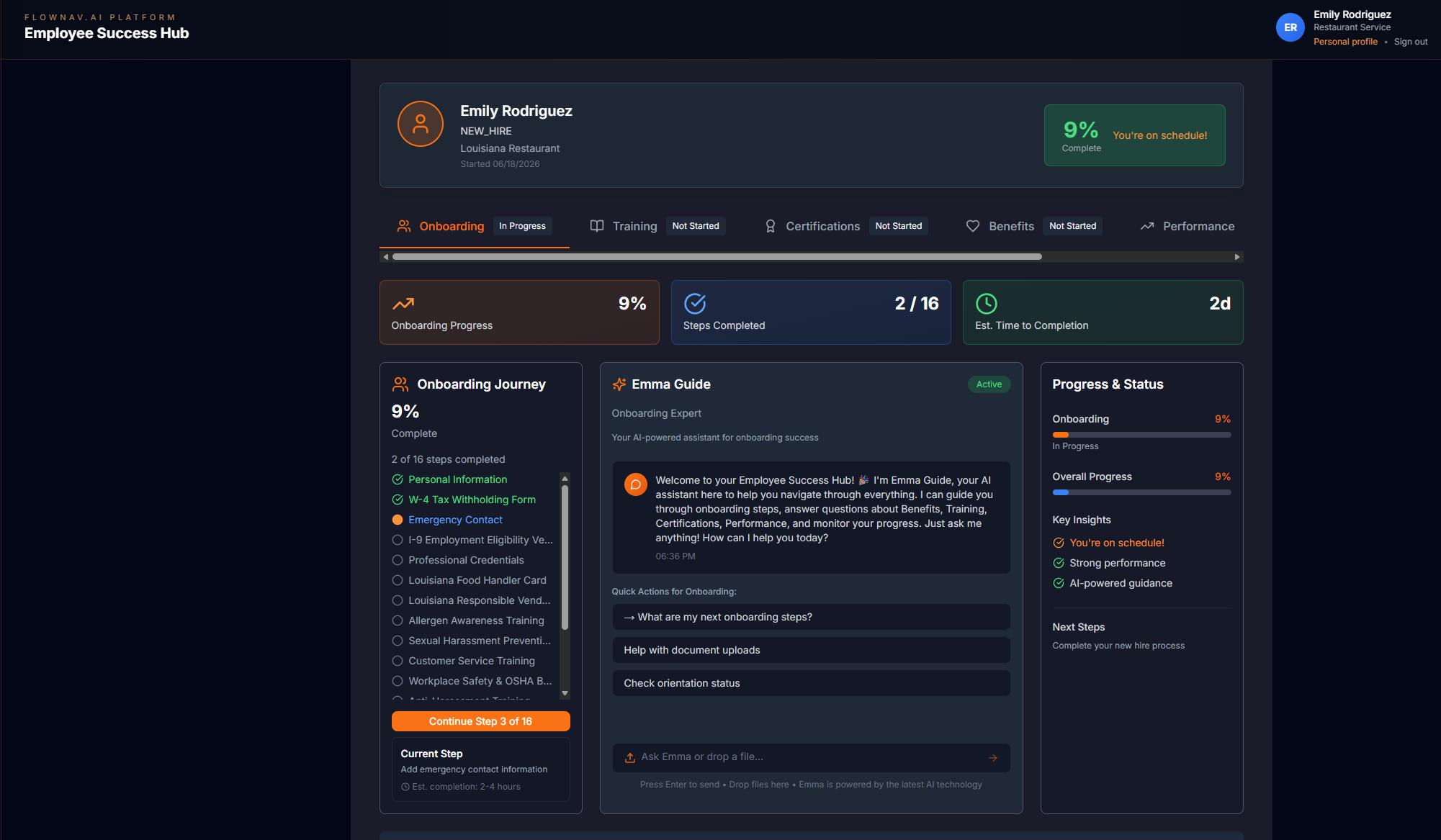
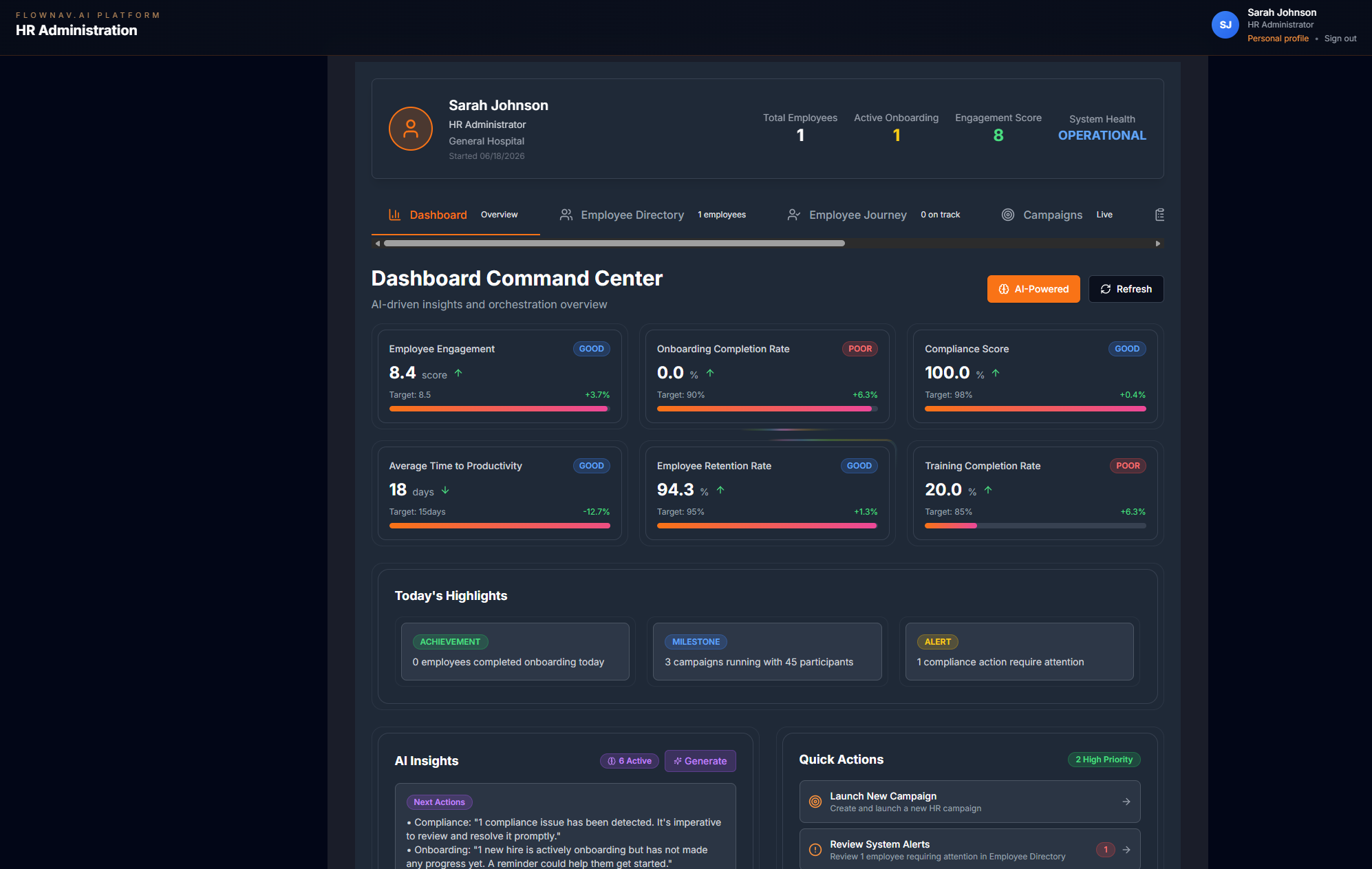
This is not a collection of modules. Emma connects every surface through shared context, role-based guidance, and coordinated execution. It is one system, already coordinating across functions.
Emma is not a chatbot. Not a copilot. Not an AI assistant bolted on.

Incomplete certification step detected for a nurse on tomorrow’s early shift.
Understands the employee, role, facility, shift timing, and compliance risk.
Surfaces the readiness issue to the manager before it becomes an operational miss.
Routes the right action to the right person with full context.
Readiness flag updates when resolved. The system stays coordinated.
Emma surfaces your next required step — training, certification, onboarding action, or readiness gap — before you have to ask.
Watch FlowNav coordinate real workflows across live surfaces.
Three live surfaces. One coordinating intelligence.
Real workforce scenarios — onboarding, compliance readiness, shift exceptions.
No demo environment setup required — Emma is already running.
Workforce operations is the entry point, not the ceiling. FlowNav enters through the highest-frequency coordination domain — where proving orchestration creates the foundation for everything that follows. Once the operating system is proven in workforce, it expands surface by surface into every function where businesses lose visibility, margin, and execution speed.
FlowNav enters through workforce operations because it is where coordination pain is immediate, measurable, and expensive — and where proving orchestration creates the foundation for everything that follows.
Once workforce coordination is proven, Emma expands into the adjacent operating surfaces where decisions, handoffs, and financial consequences accumulate — turning isolated functions into one coordinated operating layer.
FlowNav becomes the complete business operating layer — with autonomous agents executing across functions, a compounding intelligence marketplace that no point solution can replicate, and verticalized surfaces that deploy the full OS into any industry.
See FlowNav coordinate real workflows across live surfaces — and understand why the next operating system will be built for orchestration, not records.
For investors, design partners, and operators who want to see the system in motion.